 WuffConnect
Guide
Meeting other dogs on the lead: how to stay relaxed
Barking, pulling, jumping up – meeting other dogs on the lead is the biggest challenge of the walk for many dogs and owners. Distance, curves, body language and small everyday exercises make it calmer.
Why on-lead encounters can be so stressful
Off the lead, dogs often resolve encounters themselves: they walk a curve, sniff to the side, approach slowly or avoid each other. On the lead they lack exactly this room. On narrow paths they also meet head-on – for many dogs an impolite, uncomfortable situation.
Then there is the lead itself: when it gets tight, the dog feels pressure and our tension. Some dogs react by barking and lunging, others desperately want to get there and pull. Neither is usually a “dominance problem” – it is excitement, insecurity or frustration.
Good to know: a quick “hello” on the lead is often more stress than fun for dogs. It is perfectly fine to pass each other in a friendly way without the dogs making contact.
Distance and curves: your most important tools
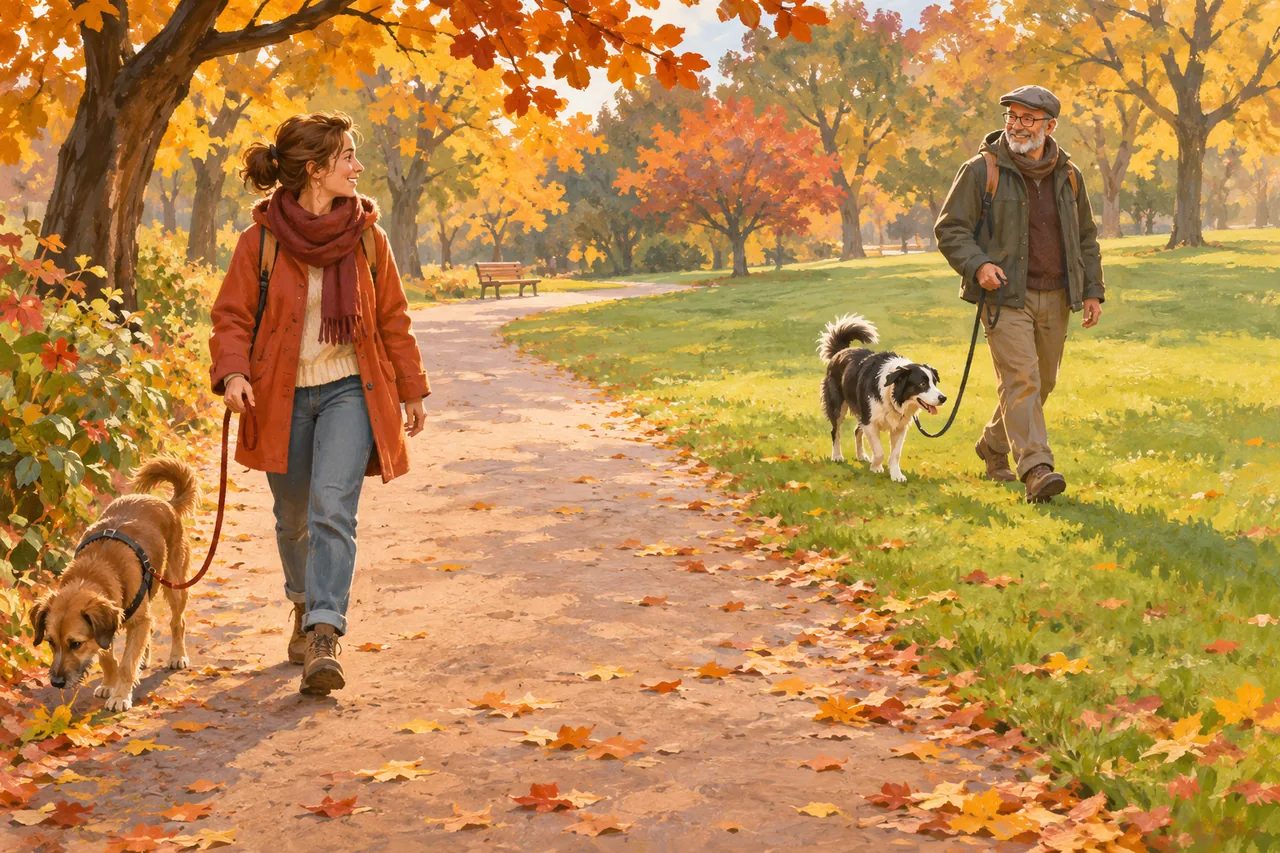
The simplest trick is often the most effective: more distance. Switch sides of the path early, walk a curve across the grass or wait briefly in a driveway until the other dog has passed. Every metre helps your dog stay calm.
Walk between your dog and the oncoming team. That way you are the “buffer” and your dog does not have to handle the encounter alone. A parked car, a hedge or a bench as a visual screen can also help.
Stepping aside is not failure, it is consideration – for your dog and for the other team, who may be practising too.
Reading body language – your own dog and others
Most dogs show early that an encounter is too much: they stare at the other dog, stiffen, slow down or stop, close their mouth or raise their tail. If you notice this in time, you can react before your dog “boils over”.
Good signs are looking away, sniffing at the side of the path, a loose body and a relaxed lead. Reward exactly these moments – with a calm voice or a treat.
Watch the other team too: if a dog wears a yellow ribbon or a yellow bandana, the owner often wants to show that the dog needs space. If in doubt, just ask briefly or walk a wide curve.
Small exercises for everyday life
Reward eye contact: when your dog sees another dog and then looks at you, praise or treat. This teaches that calm pays off. Start at a large distance where your dog is still relaxed.
Practise a U-turn: at home and on quiet paths, train a cheerful cue for turning around, such as “Let’s go”. Once it works reliably, you can use it when a dog suddenly appears round the corner.
Short and often: two or three successful encounters at a distance every day are better than one long session. After a difficult moment, give your dog a sniffing break.
If your dog barks or lunges very strongly, or its behaviour changes suddenly, first have a vet check whether pain is involved, then get support from a dog school – a one-to-one session is often the best start.
Practising together: with calm walking buddies
Dogs learn encounters most easily with a familiar, relaxed dog. With a walking buddy you can arrange to meet at a large distance on an open meadow, walk in parallel and reduce the distance step by step – without surprises.
On WuffConnect you find dog owners near you for calm walks like these and can note in your profile what suits your dog. In the partner list dog schools and trainers also introduce themselves with address and contact.
Frequently asked questions
Should dogs greet each other on the lead?
Not necessarily. Many dogs find encounters on a short lead stressful because they cannot move away. Passing in a friendly way without contact is perfectly fine. If both owners agree and the dogs seem relaxed, brief contact on a loose lead can work.
My dog barks at every dog on the lead – what can I do?
First increase the distance until your dog can stay calm and reward calm behaviour there. If the behaviour is strong or suddenly new, have your vet check whether pain plays a role, and get support from a dog school.
What does a yellow ribbon on the lead mean?
A yellow ribbon or bandana is a voluntary sign many owners use to show that their dog needs space – for example because it is unsure, ill or in training. It is not an official sign, but a good request for consideration.
What do I do if an off-lead dog runs towards us?
Stay as calm as possible, kindly ask the owner to call their dog, and if possible stand between the two dogs. Then keep walking briskly instead of standing still.
Relaxed walks for two
Find calm walking buddies near you and practise encounters together, at your own pace – free.
Sign up for free